VA Aid & Attendance Benefit: Complete Guide for 2025
Last Updated: April 2, 2026
VA Aid & Attendance is a tax-free benefit that provides up to $2,431 per month (2025 rates) for veterans who need assistance with daily activities like bathing, dressing, or eating. This benefit is paid in addition to VA pension and helps veterans afford professional home care services. Understanding eligibility requirements, application procedures, and how to maximize your benefits ensures you receive the full financial support you've earned through military service.
What is VA Aid & Attendance?
Aid & Attendance (A&A) is an increased pension benefit for veterans and surviving spouses who require the regular assistance of another person to perform activities of daily living, are bedridden, are patients in nursing homes, or have severe vision impairment.
- Tax-free benefit: Not counted as taxable income
- Paid monthly: Direct deposit on the first business day of each month
- Added to pension: Paid in addition to basic VA pension amount
- Covers home care: Can be used to pay for in-home caregivers, assisted living, or nursing home care
- No service-connected requirement: Does not require service-connected disability rating
2025 VA Aid & Attendance payment rates
The VA adjusts Aid & Attendance rates annually based on cost-of-living increases. Here are the 2025 maximum annual pension rates (MAPR) including Aid & Attendance:
2025 Monthly Rates
- Veteran without dependents: $2,431/month ($29,175/year)
- Veteran with one dependent: $2,846/month ($34,149/year)
- Two veterans married to each other: $3,835/month ($46,019/year)
- Surviving spouse: $1,546/month ($18,551/year)
These amounts represent the maximum you can receive. Your actual benefit is calculated by subtracting your countable income from the MAPR for your category.
Who qualifies for VA Aid & Attendance?
Eligibility for Aid & Attendance requires meeting both service requirements and medical/functional requirements.
Service requirements
- Wartime service: At least 90 days of active military service, with at least one day during a VA-recognized wartime period
- Honorable discharge: Discharged under conditions other than dishonorable
- Age or disability: Age 65 or older, OR permanently and totally disabled (not necessarily service-connected)
VA-Recognized Wartime Periods
- Mexican Border Period: May 9, 1916 – April 5, 1917
- World War I: April 6, 1917 – November 11, 1918
- World War II: December 7, 1941 – December 31, 1946
- Korean War: June 27, 1950 – January 31, 1955
- Vietnam War: November 1, 1955 – May 7, 1975 (or August 5, 1964 – May 7, 1975 for veterans who served in Vietnam)
- Gulf War: August 2, 1990 – present
Medical and functional requirements
You must meet at least one of these conditions:
- Need another person's help performing activities of daily living (bathing, dressing, eating, using toilet, transferring)
- Require supervision or protective care due to mental incapacity (dementia, Alzheimer's, PTSD)
- Are bedridden (confined to bed due to disability)
- Are a patient in a nursing home due to mental or physical incapacity
- Have corrected vision of 5/200 or less in both eyes, or visual field limitation to 5 degrees or less
Income and asset limits
Aid & Attendance is a needs-based benefit, meaning you must have limited income and assets.
- Income limit: Your countable income must be less than the MAPR for your category (see rates above)
- Countable income: Includes wages, Social Security, retirement, investment income, MINUS unreimbursed medical expenses (including home care costs)
- Asset limit: No specific dollar limit, but assets must not be sufficient to live on without financial hardship. Net worth above $160,194 (2025) may disqualify you
- Excluded assets: Primary residence, one vehicle, personal belongings, prepaid funeral/burial
How to apply for VA Aid & Attendance
The application process requires careful documentation and can take 3-6 months or longer. Many veterans work with accredited Veterans Service Organizations (VSOs) for free application assistance.
Step 1: Gather required documents
- DD-214: Certificate of discharge showing service dates and character of discharge
- Marriage certificate: If claiming benefits for spouse
- Dependent information: Birth certificates for dependent children
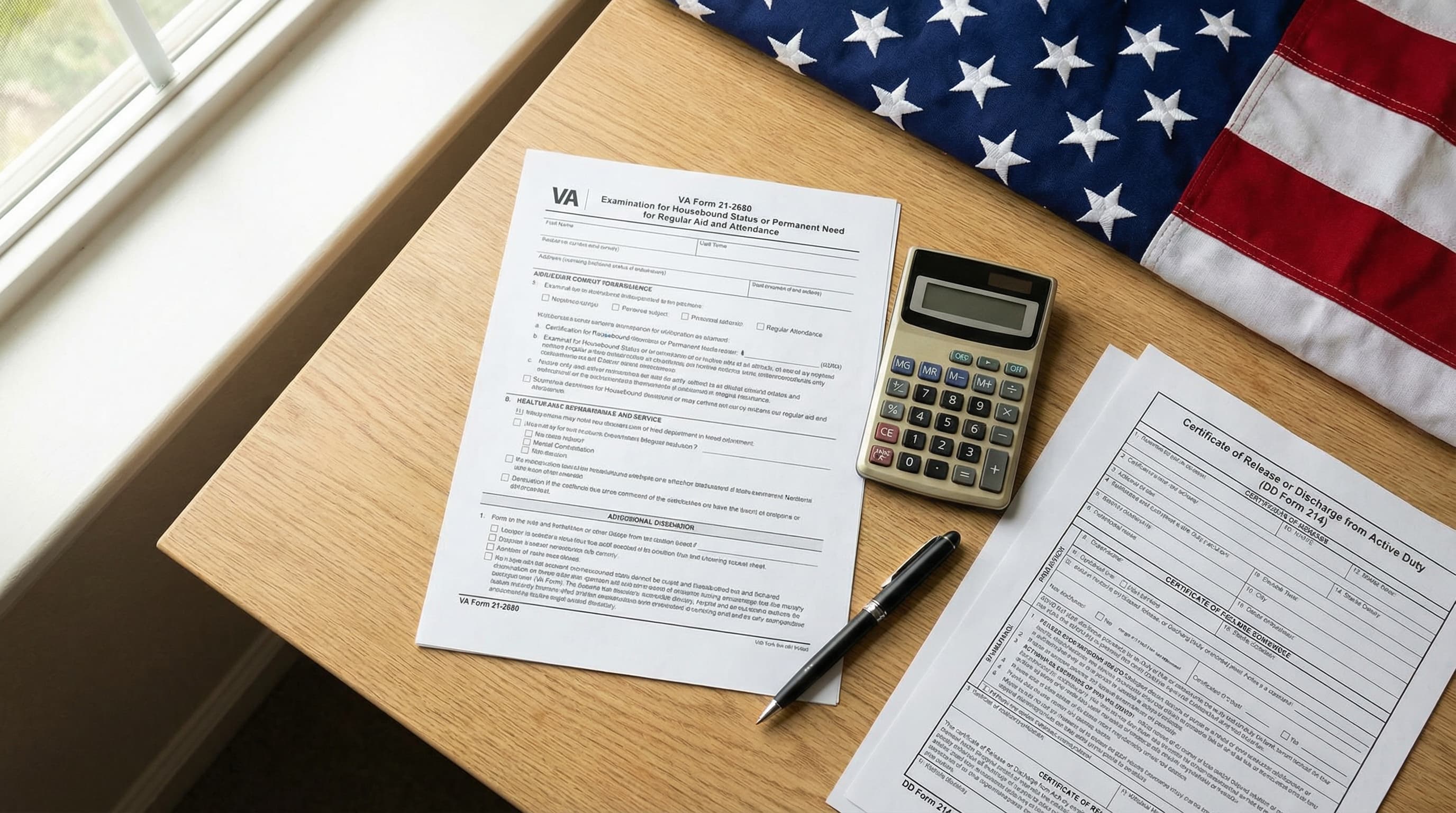
- Medical evidence: Doctor's statement on VA Form 21-2680 (Examination for Housebound Status or Permanent Need for Regular Aid & Attendance)
- Income records: Social Security statements, pension statements, tax returns
- Asset documentation: Bank statements, investment accounts, property deeds
- Expense records: Medical bills, home care invoices, prescription receipts
Step 2: Complete application forms
- VA Form 21P-527EZ: Application for Pension (primary form)
- VA Form 21-2680: Examination for Housebound Status or Permanent Need for Regular Aid & Attendance (completed by physician)
- VA Form 21-0779: Request for Nursing Home Information (if applicable)
Step 3: Submit application
You can submit your application through multiple channels:
- Online: Upload documents through VA.gov (fastest method)
- Mail: Send to your VA Pension Management Center (address varies by state)
- In-person: Submit at regional VA office or Veterans Service Organization
- With VSO help: Work with accredited representative from VFW, DAV, American Legion, or county veterans service office (free assistance)
Step 4: Wait for decision
Processing times average 3-6 months but can take up to 12 months. Check application status at VA.gov or call 1-800-827-1000. If approved, benefits are paid retroactively to your application date (or the date you became eligible, whichever is later).
Maximizing your Aid & Attendance benefit
Understanding how the VA calculates your benefit helps you maximize the amount you receive.
Deduct unreimbursed medical expenses
The VA subtracts unreimbursed medical expenses (UMEs) from your countable income when calculating your benefit. This means higher medical expenses can increase your A&A payment.
- Home care costs: In-home caregiver expenses, even if paid to family members in some cases
- Assisted living fees: Monthly fees for assisted living facilities
- Medical equipment: Wheelchairs, hospital beds, oxygen
- Prescriptions: Out-of-pocket medication costs
- Medicare premiums: Part B, Part D, Medicare Supplement insurance
- Adult day care: Veteran-specific or general adult day programs
Document everything
- Keep receipts for all medical and care-related expenses
- Maintain contracts with care providers
- Document frequency and type of care received
- Get physician statements that detail your functional limitations
Common Aid & Attendance mistakes to avoid
- Incomplete medical documentation: Form 21-2680 must clearly describe your functional limitations. Generic statements like "needs assistance" are insufficient.
- Not reporting income changes: You must report changes in income within 30 days, or risk overpayment that must be repaid.
- Transferring assets: The VA has a 3-year look-back period. Transferring assets to qualify can delay benefits or result in denial.
- Paying unaccredited "pension poachers": Work only with VA-accredited representatives. VSOs provide free help. Never pay upfront fees.
- Missing supporting documentation: Include all evidence with initial application to avoid delays from development requests.
Aid & Attendance vs. other VA benefits
Understanding how Aid & Attendance differs from and interacts with other VA benefits helps you maximize your support.
Key Differences
- A&A vs. VA Disability: A&A is needs-based (income/asset limits). VA disability is service-connected (no income limits). You cannot receive both simultaneously for the same disability.
- A&A vs. Housebound: Housebound benefit ($1,253/month for 2025) is lower than A&A and for veterans substantially confined to home but not needing regular assistance.
- A&A vs. VA Health Care: A&A is cash benefit you control. VA health care is medical services through VA providers. You can receive both.
- A&A vs. Veterans Directed Care: VDC is a VA program that funds veteran-chosen caregivers. A&A is cash you can spend on any care provider.
Using Aid & Attendance for home care
Aid & Attendance benefits can be used to pay for professional in-home care services, allowing veterans to remain independent at home rather than moving to institutional care.
- Hire professional caregivers: Use benefits to pay for licensed home care agencies or independent caregivers
- Flexible care schedules: Pay for care as needed (hourly, overnight, live-in)
- No VA approval needed: Choose your own care provider without VA authorization
- Combine with other funding: Use A&A alongside family support, long-term care insurance, or state programs
Local Veteran-Friendly Home Care Provider
Veteran-friendly in-home care services are available and assistance with VA Aid & Attendance benefit applications at no additional charge.
Ohio: (740) 276-8611 | Mid-Ohio Valley
Maryland: (443) 291-7100 | Southern Maryland
Getting help with your application
Free accredited help is available through Veterans Service Organizations (VSOs). These organizations have trained representatives who can assist with your entire application at no cost.
- Veterans of Foreign Wars (VFW): vfw.org | 1-800-839-1899
- Disabled American Veterans (DAV): dav.org | 1-877-426-2838
- American Legion: legion.org | 1-800-433-3318
- County Veterans Service Offices: Local offices in most counties (Ohio: Ohio resources, Maryland: Maryland resources)
- VA Regional Offices: Schedule appointment at va.gov or 1-800-827-1000
Related Resources
- What is Veterans Home Care? →
Learn about professional in-home assistance tailored to military veterans
- Paying for Veterans Care →
Explore all funding options including TRICARE, Medicare, and state veteran programs
- Choosing a Veteran-Friendly Provider →
Questions to ask when selecting care providers that understand military culture